perfectionism-hypnotherapy-tampa
 Monica Obando
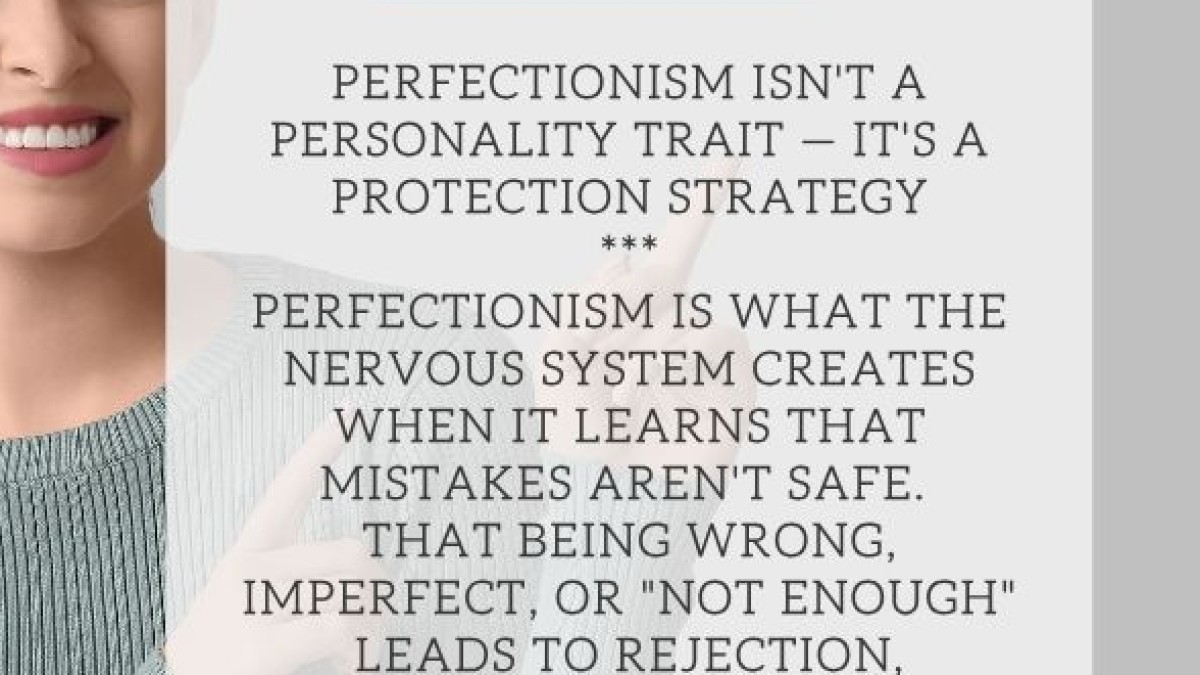
If you've ever described yourself as a perfectionist, you've probably received one of two reactions: admiration, or...
If you've ever described yourself as a perfectionist, you've probably received one of two reactions: admiration, or a gentle suggestion to "just let it go."
Neither is particularly helpful. Because perfectionism, the real kind, the kind that keeps you stuck and exhausted, isn't about standards. And it doesn't respond to willpower or mindset shifts.
As a Certified Clinical Hypnotherapist serving clients in Tampa, Lutz, Wesley Chapel, and virtually worldwide, I work with perfectionism almost every week. And what I've found, consistently, is this: perfectionism isn't a personality trait. It's a protection strategy built by a nervous system that learned, at some point, that imperfection was dangerous.
Understanding that changes everything.
What Perfectionism Actually Is
Perfectionism is the subconscious mind's attempt to stay safe by controlling outcomes. It's built on a core belief, usually formed in childhood or adolescence, that goes something like this:
If I do everything perfectly, I won't be rejected. If I don't make mistakes, I'll be loved. If I always get it right, I'll be safe.
That belief doesn't form in a vacuum. It forms in response to real experiences: a critical parent, an environment where mistakes had consequences, a childhood where love felt conditional on performance, or a period of humiliation or rejection that the nervous system decided it never wanted to repeat.
So it built a strategy. And for a while, that strategy probably worked. It kept you safe, helped you succeed, earned you praise.
But strategies built for one environment don't always translate to another. You grew up. Your circumstances changed. But the subconscious kept running the same program, because no one ever told it the threat had passed.
The Hidden Cost of Perfectionism
From the outside, perfectionism can look like a strength. Detail-oriented. High standards. Dedicated. People often receive compliments for it.
But from the inside, it's exhausting in ways that are hard to articulate:
The paralysis of starting. If something can't be done perfectly from the beginning, the subconscious resists beginning at all. Why start if you might fail? Why put yourself out there if it might not be good enough?
The impossibility of finishing. There's always something that could be improved. Always a reason to revise one more time, rework one more section, wait one more day before sending. Completion feels like exposure, because once something is out in the world, it can be judged.
The exhaustion of maintaining. The mental energy required to constantly monitor for mistakes, anticipate criticism, and ensure nothing goes wrong is immense. Perfectionists are often deeply tired, not from what they're doing, but from the vigilance of doing it perfectly.
The loneliness of the standard. Perfectionists are almost always far harder on themselves than they would ever be on anyone else. There's a private harshness that rarely gets spoken about, and that rarely responds to being told to "be kinder to yourself."
Why "Just Lower Your Standards" Doesn't Work
The advice most perfectionists receive, relax, done is better than perfect, be easier on yourself, comes from a genuinely kind place. But it operates at the wrong level.
Your conscious mind might fully agree that done is better than perfect. You might even believe it. But your nervous system is still running the old calculation: imperfect action = threat. And your nervous system is faster, older, and louder than your conscious reasoning.
You can't think your way out of a survival strategy. You can manage it temporarily. But the underlying program keeps running.
This is why so many intelligent, self-aware people find that perfectionism persists even after years of therapy, self-help books, and genuine effort to change. They've worked on the symptom. But the root, the subconscious belief that safety requires perfection, is still intact.
How Hypnotherapy Approaches Perfectionism
Hypnotherapy works by accessing the subconscious level where the perfectionism strategy lives, and allowing it to update.
In the deeply relaxed, focused state of hypnosis, we can:
Find the original experience. Often there's a specific moment, or a pattern of moments, where the nervous system first concluded that imperfection was unsafe. Bringing that experience into awareness, with the safety of the present moment, allows something to shift that cognitive insight alone can't reach.
Complete the emotional charge. Perfectionism is often driven by unprocessed shame or fear from the past. Hypnotherapy allows the nervous system to process and discharge that emotion, so it no longer needs to drive behavior.
Update the core belief. At the root of most perfectionism is some version of I am not enough as I am. In hypnotherapy, we work with the subconscious to update this, not through affirmations or positive thinking, but through a genuine shift at the level where the belief lives.
Build new patterns. Once the protective function of perfectionism is no longer needed, we install new defaults: the ability to start without perfect conditions, to finish without endless revision, to rest without guilt, to be seen without fear.
What Changes
Clients who do this work often describe a specific kind of relief: not that they no longer care about quality, but that they're no longer driven by fear. They can do good work from a grounded place rather than an anxious one. They can start things. Finish things. Let things be good enough — and actually feel okay about it.
The exhaustion lifts. The internal critic quiets. Not because standards dropped, but because safety is no longer contingent on perfection.
Is This You?
This work tends to resonate deeply with people who:
- Have been aware of their perfectionism for years but can't seem to shift it
- Feel more exhausted by their own internal standards than by external demands
- Know intellectually that they're enough, but don't feel it in their body
- Experience procrastination and perfectionism as the same stuck cycle
- Are tired of managing it and ready to actually clear it
If that's you, I'd love to talk.
I offer a free 30-minute consultation where we can explore what's underneath your perfectionism and whether hypnotherapy is the right fit. Sessions available in person in Lutz, FL — serving Tampa, Wesley Chapel, New Tampa, Land O' Lakes, and surrounding areas — and virtually throughout Florida and worldwide.
Sessions in English and Spanish (sesiones disponibles en español).
→ Book your free consultation at monicaobando.com