/generational-patterns-hypnotherapy-tampa
 Monica Obando
Generational trauma patterns are passed down through families, often without anyone realizing it. Learn how hypnotherapy helps break the...
You Didn't Choose These Patterns, But You Can Be the One Who Breaks Them
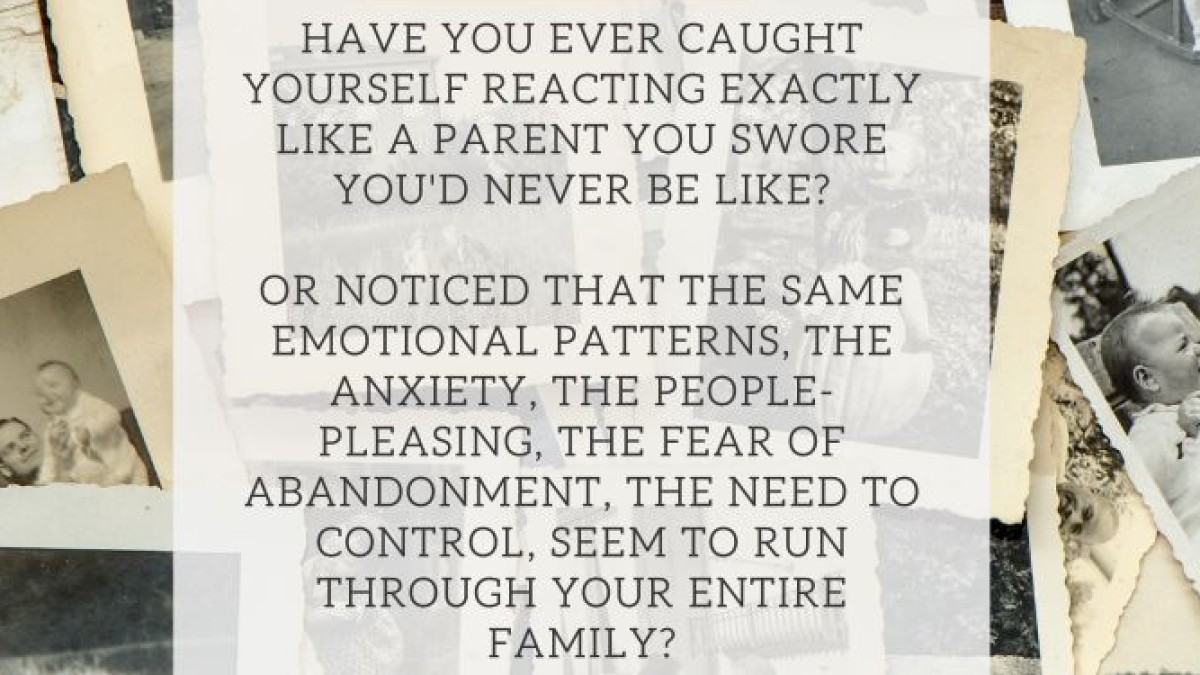
Have you ever caught yourself reacting in a way that felt uncomfortably familiar, because it was exactly how a parent or grandparent would have reacted?
Or noticed that the same emotional themes seem to run through your family for generations, the anxiety, the people-pleasing, the emotional distance, the pattern of relationships where love never quite feels safe?
That's not a coincidence. And it's not a weakness. It's generational patterning, and it's one of the most common, and most profound, areas of work I encounter as a Clinical Hypnotherapist serving clients in Tampa, Lutz, Wesley Chapel, and worldwide.
The important thing to understand: you didn't choose these patterns. But you absolutely can be the one who breaks them.
How Generational Patterns Get Created
Children are extraordinarily attuned to their caregivers, far more than most people realize. Long before we have language to understand what's happening around us, we're absorbing it at a nervous system level.
We're watching how the adults in our world respond to fear, stress, conflict, and love. We're learning what emotions are acceptable, what feelings must be suppressed, how much space we're allowed to take up, whether the world is fundamentally safe or fundamentally threatening.
And our subconscious minds are filing all of that away, not as stories, but as operating instructions. This is how relationships work. This is what love feels like. This is how to stay safe.
When a parent carries unresolved anxiety, that anxiety becomes the emotional atmosphere the child grows up in. When a parent's love is conditional on performance, the child's nervous system learns that worthiness must be earned. When conflict in the home is volatile or unpredictable, the child's nervous system learns to stay hypervigilant, long after the environment has changed.
None of this makes anyone a bad parent. Most of what gets passed down was itself inherited, patterns absorbed from the generation before, and the generation before that.
But the patterns keep moving forward until someone does the work to interrupt them.
What Generational Patterns Look Like
Generational patterns can be subtle, because they feel so personal, so much like simply who you are, that it can be hard to see them as inherited at all.
Some of the most common ones I work with:
Inherited anxiety. A persistent low-level fear or sense of threat with no clear current cause, but which mirrors the anxiety carried by a parent or grandparent who lived through genuinely difficult circumstances.
Conditional love dynamics. The deep-seated belief that love must be earned, that you're only acceptable when you're performing, achieving, or meeting someone else's needs, absorbed from relationships where love was withheld or inconsistent.
Emotional suppression. The inability to identify, express, or tolerate strong emotions, learned from caregivers who themselves didn't have tools for emotional processing.
People-pleasing and boundary difficulties. The compulsion to prioritize everyone else's comfort over your own, often rooted in family systems where keeping the peace was essential to safety.
The not-enough belief. A persistent sense of inadequacy or unworthiness, frequently traceable to a parent who carried the same belief, often unconsciously communicating it through criticism, emotional unavailability, or impossible standards.
Relationship patterns. The repetition of dynamics, emotional unavailability, fear of abandonment, cycles of closeness and withdrawal, that mirror what was modeled in childhood.
Why Understanding the Pattern Isn't Enough to Change It
This is the question I hear most often from clients who've already done significant therapeutic work: I understand where this pattern comes from. I've traced it back. I've talked about it for years. Why won't it change?
The answer lies in where the pattern is stored.
Intellectual understanding is a conscious process. But generational patterns, like most deep emotional patterns, live in the subconscious. They're encoded in the body's automatic responses, in the nervous system's default settings, in the deeply held beliefs that were formed before you had the cognitive capacity to examine or question them.
Cognitive understanding can tell you where the pattern came from. But it can't reach the level where the pattern actually lives.
This is why talk therapy, for all its genuine value, sometimes has limits when it comes to deep generational work. You can build enormous insight about the pattern. But the subconscious keeps running the original programming until something intervenes at that level.
How Hypnotherapy Breaks Generational Cycles
Hypnotherapy creates direct access to the subconscious, where generational patterns are stored. In the deeply relaxed, focused state of hypnosis, we can do what cognitive work alone cannot:
Trace the pattern to its origin. We follow the emotional thread back, often to specific moments in childhood, or sometimes even to what clients describe as a felt sense of inherited experience — and bring those moments into the safety of the present.
Release the stored emotional charge. Generational patterns carry emotional energy, grief, fear, shame, anger, that was never processed. Hypnotherapy allows the nervous system to complete what couldn't be completed at the time.
Separate inherited beliefs from authentic self. Clients often discover, in this work, that the voice telling them they're not enough, or that love is unsafe, or that they have to earn their place, isn't actually their voice. It's an inherited one. Creating that separation is profoundly liberating.
Update the subconscious operating instructions. Once the original pattern is released, we install new beliefs, new nervous system responses, new defaults, ones that you consciously choose, rather than unconsciously inherit.
The Lineage Impact
This is the piece of this work that moves me most deeply.
Every pattern that heals stops being passed forward.
The anxiety you resolve, your children don't inherit. The relationship dynamic you break, your children don't repeat. The belief that you're not enough, when that finally shifts in your nervous system, it shifts the template for the people who come after you.
You didn't choose the patterns you were given. But you can choose what you pass forward.
Ready to Break the Cycle?
If you recognize your family's emotional patterns in yourself, and feel ready to do something about it, I'd be honored to work with you.
I offer a free 30-minute consultation where we can explore what patterns you're carrying and whether hypnotherapy is the right fit. Sessions in person in Lutz, FL (serving Tampa, Wesley Chapel, New Tampa, Land O' Lakes, and surrounding areas) and virtually throughout Florida and worldwide.
Sessions in English and Spanish (sesiones disponibles en español).
→ Book your free consultation at monicaobando.com
Monica Obando is a Certified Clinical Hypnotherapist (CCHt, CTACC, RYT) specializing in generational patterns, trauma, and subconscious healing. She serves clients in Tampa Bay and worldwide.