/emotional-regulation-hypnotherapy-tampa
 Monica Obando
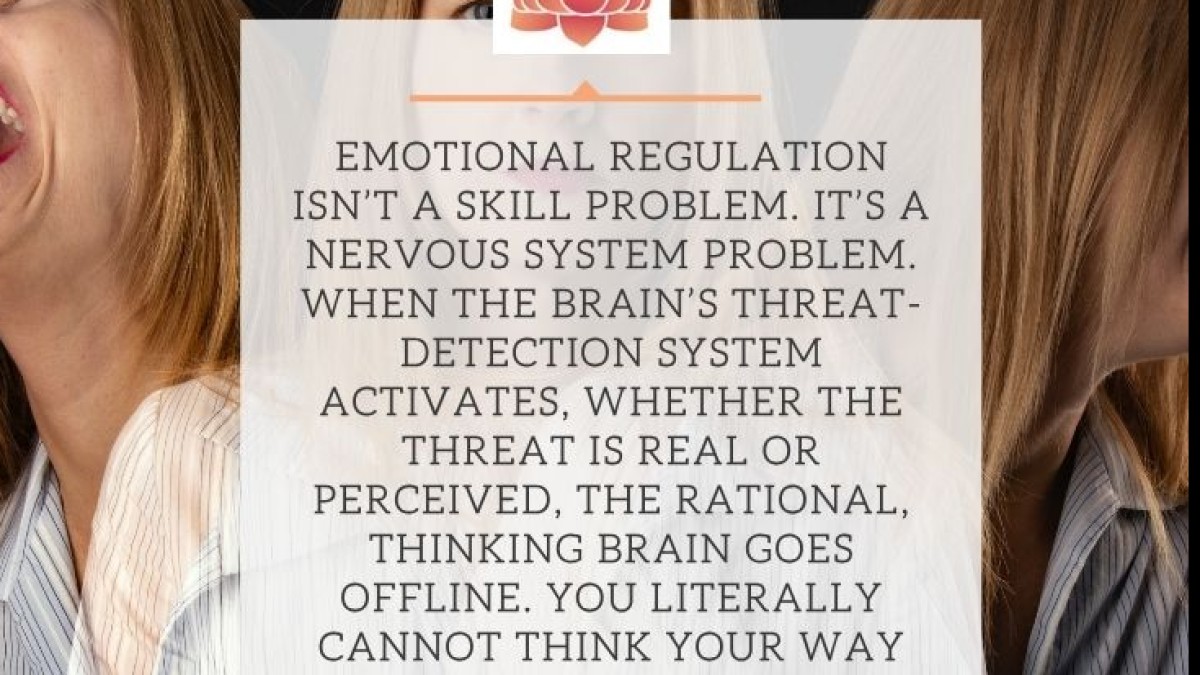
Breathing and mindfulness help, but they don’t reach the nervous system root of emotional dysregulation. Learn how hypnotherapy creates lasting change
If you’ve ever been told to “just breathe” in the middle of an emotional spiral — and found it completely unhelpful — you’re not doing it wrong.
The problem isn’t the technique. It’s that the technique is being applied at the wrong level.
As a Certified Clinical Hypnotherapist serving clients in Tampa, Lutz, Wesley Chapel, and virtually worldwide, I work with emotional regulation regularly. And what I’ve found, consistently, is this: emotional dysregulation isn’t a skill deficit. It’s a nervous system pattern — one that lives below the reach of conscious strategies.
The Biology Behind Emotional Overwhelm
When your brain perceives a threat — whether real or perceived, physical or emotional — the amygdala activates the survival response. In that activated state, blood flow shifts away from the prefrontal cortex: the region responsible for rational thinking, impulse control, perspective-taking, and language.
You don’t just feel like you can’t think clearly. You actually can’t. The biology has temporarily reduced your access to the faculties you’d need to regulate consciously. This is why breathing and counting to ten work beautifully in calm moments — and feel impossible in activated ones.
Why Some Nervous Systems Dysregulate More Easily
The threshold at which your nervous system fires the threat response — and the time it takes to return to baseline — is shaped by history. A nervous system that grew up in chronic stress, unpredictability, or emotional volatility learns to keep the alarm set lower. Ready to fire faster. Because in that environment, readiness was protection.
That adaptation made sense then. But the settings persist long after the environment changes. The reactivity, the overwhelm, the emotional shutdown — these are not character flaws. They are the residue of a nervous system that was doing its job.
What Lasting Regulation Actually Requires
Surface-level regulation strategies — breathwork, grounding exercises, cognitive reframing — are valuable. But they operate at the conscious level. For people whose dysregulation has deep roots, they produce management rather than change.
Lasting regulation requires working at the level of the nervous system itself:
• Releasing the stored emotional charge from past experiences keeping the threat response sensitized
• Updating the subconscious associations triggering the alarm
• Building new nervous system pathways and default responses
• Shifting the baseline — not just the in-the-moment coping
This is precisely what hypnotherapy offers. By accessing the subconscious in a deeply relaxed state, we can reach the stored patterns and associations that conscious strategies cannot touch — and begin to change them at the source.
What Clients Experience
Clients who work with me on emotional regulation often describe a gradual but unmistakable shift: the triggers don’t land as hard. The spikes don’t go as high. The return to calm is faster and more complete. Not because they’re working harder to regulate — but because their nervous system has genuinely updated its baseline.
→ Book your free consultation at monicaobando.com
Hypnosis Therapy Sessions in English and Spanish. In person in Lutz, FL and virtually worldwide.